YouTube

Showing posts with label Business in Bharat. Show all posts

Wednesday, 12 May 2021

Handmade paper from Bharat: Kagaj: Pre-independence since Buddhist Era

Jay Shree Ram friends! Here is one more group of one liners for you regarding the business of paper manufacturing history in Bharat. Please read till the end.
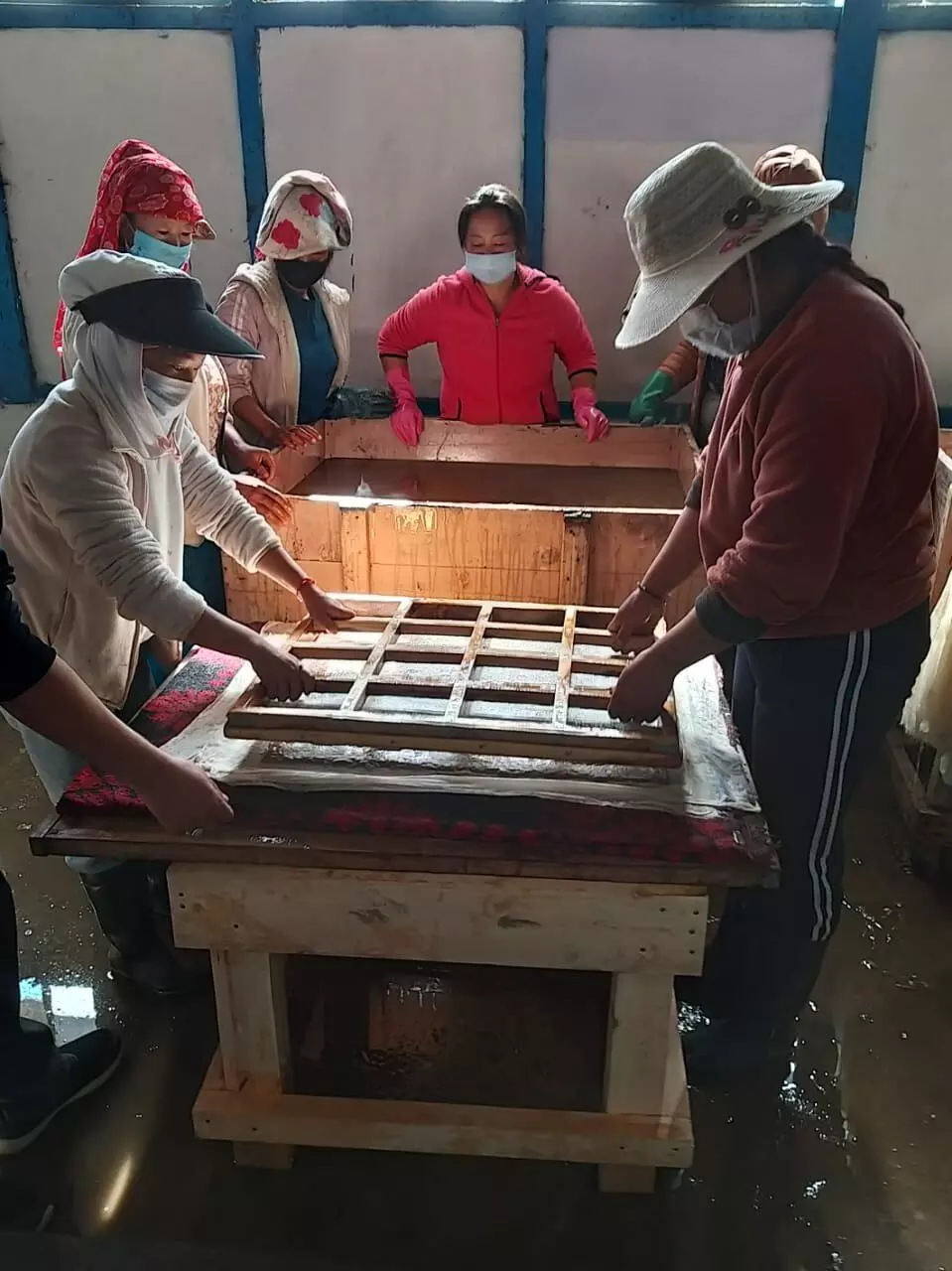
Image: Aap Ki Khabar


Handmade paper from Bharat: Kagaj:

Kagaj: Pre independence since Buddhist Era

ð  Some people believe paper was invented independently in Indiain Buddhist times around 250 BC.

ð  Archaeological finds at Gilgit in the vale of Kashmir indicate that paper was already applied in the Himalayas in the sixth century AD.

ð  Some records make mention of occasionally use of paper for religious purposes in the seventh century AD.

ð  A Sanskrit dictionary about one hundred years later from Buddhist era gives two versions of the Persian word for paper and one for the Chinese word.

ð  Paper thus is known some time before the muslim era.

ð  They have the oblong format of palm leaf and the scribes continue to leave an open space for the holes of the ropes that originally kept the palm leaf books together.

ð  The Hindu, Buddhist and Jain persevere in recording their texts on palm leaf long after paper becomes a popular writing material.

ð  The earliest centers of white art are Daulatabad, Lahore, Sailkot, Ahmedabad and Kashmir since 13th century

ð  Before that the Muslim courts in Delhi probably import paper from Persia.

ð  The Emperor Akbar (1556-1605) in particular takes a keen interest in the book arts, although he himself is an illiterate. He has more than 100 painters living at his court and is said to have possessed a library of 24,000 volumes.

ð  During the reign of his son Jehangir (1605-1627) the city of Sailkot in the Punjab becomes the most important centre of papermaking.

ð  1500 Denkhi, the traditional Indian rice stamper, are producing pulp for the paper mills.

ð  Hundreds of kagjipura arise, settlements where the Moslem papermakers, the kagji, live and work.

ð  A peculiar writing material developed amongst the merchants of Mysore. They wrote with soapstone or chalk on a cotton cloth impregnated with tamarind seed paste and blackened with charcoal. These folding books were in use as account books, called kaditam.

ð  A certain Balaji Abaji, a Thakur from the Kshatriya caste, left around 1800 his village Roje in Maharashtra together with several other residents. He wanted to start up papermaking at Nasik. The inhabitants of Roje however summoned Balaji because he would harm the village welfare by leaving. Fortunately for Balaji Abaji the legal officer in charge agreed with him. The inhabitants of Roje did not win their case. After 90 years the mill still stands and Nasik had a prosperous paper industry for a long time.

ð  The first Robert's paper-machine enters the Indian continent as early as 1832, two years earlier than in the Netherlands. Dr. William Carey, starts to make paper by machine in Serampore. By 1870 eight paper-machines are in operation. The next 20 years many more are working most of them in the Bombay and in the Calcutta area.

ð  The reports on the grasses munj and bhabar show the most promising results. When at last Raitt discovers how to digest bamboo properly that plant becomes a very popular raw material for the steam driven paper plants.

ð  With the Bamboo Paper Industry Act of 1925 the colonial government protects the local paper mills.

ð  The first paper mill, the Kalam Kush Paper Mill, based on Gandhian ideas was established.

ð  The fully cotton hosiery of the so detested cotton mills of Ahmedabad could be miraculously changed into wonderful papers. The transformation of textile waste thus also became a strong political act of a nationalistic movement against its oppressors.

ð  When on the 15th of August 1947 India at last reaches its independence the Gandhian ideas are incorporated into the new constitution.

ð  Although Nehru, India's first Prime Minister, initially does not agree on Gandhi's economical ideas he changes his mind and thinks that the cottage industry could well be the answer to unemployment.

ð  The Khadi Village and Industries Commission (KVIC), founded in 1957, has the difficult task to stimulate and protect the cottage industry. The KVIC was and still is today a powerful stimulator of kagji.


 Reference: Teygeler, R (1998) Handmade paper from India. Kagaj: yesterday, today and tomorrow in: IPH Congress Book, 1998(12). International Association of Paper historians, Marburg, 2002: pp.185-194.

===========

Thanks for reading till the end. If you are knowing about any historical business then please comment below. I will share the details of that business for the general knowledge of everyone.


My YouTube Channel

https://www.youtube.com/channel/UC4omGoxEhAT6KEd-8LvbZsA

History of Bharat on my Facebook Page

https://www.facebook.com/Know-India-with-my-questions-100970508755047

My Twitter handle

https://twitter.com/rohinigilada2

Join my telegram group for my all online activities

https://t.me/bharatismyprid

Read my other blogs

1) https://articindia.blogspot.com

2) https://hindihaven.blogspot.com

3) https://storilia.blogspot.com

4) https://knowgeomaticindia.blogspot.com

5) https://notesdynamo.blogspot.com


Handmade paper from Bharat: Kagaj: Modern Era

Jay Shree Ram friends! Here is an article about Handmade paper business in Bharat. These are just one liners for your knowledge. Please read till the end.

Image: MoneyShri


Handmade paper from Bharat: Kagaj:

Kagaj: Till 2002

ð  Till 2002 the KVIC supports some 450 handmade paper enterprises all over India.

ð  Most of the states have their own Khadi Village and Industry Board that backs up the kagji in their region.

ð  Later Around Daulatabad 1800 once royal fortress became famous for its fabulous afshani paper, paper mottled with small pieces of gold leaf. In 1995 the mill of Daulatabad was close down.

o   Note: Till 1995 there was rule of Indian National Congress (INC) in State Assembly of Maharashtra. In 1995 BJP and ShivSena alliance came into rule the Maharashtra then again from 1999 to 2014 it was rule of INC again.

o   Note: Since 1947 to 1977 it was rule of INC, then from 1977 to 1980 Janata Party ruled the nation. From 1980 to 1989 it was again INC. For 1989 to 1990 – few months it was Janata Dal. 1990 to 1991 It was Samajwadi Janata Dal. 1991 to 1996 again INC was ruling the nation. 1996 to 1998 the PM was of Janata Dal (united front). Since 1998 to 2004 BJP was ruling India. 2004 to 2014 it was again INC and then till the date BJP is in Centre.

o   In 1990’s INC, BJP and Shivsena ruled Maharashtra and in centre the government was not stable.

ð  Throughout the country several ashram, spiritual communities of Hindus organised around the ideas of a particular Indian philosophy, are involved in papermaking by hand. The most famous one is the Sri Aurobindo Ashram near Pondicherry in northern Tamil Nadu. Since 1959 their objective is to manufacture high quality paper from the best available raw materials. Like other modern papermakers they use waste textile from the hosiery factories. These 100% cotton rags are sorted, dusted and cut into strips before boiling with caustic soda. After mild bleach the pulp is prepared in the Hollander beater. Very often the pulp is mottled in the vat with several substances of vegetable nature like rice or wheat straw, grass, flowers, petals, husks, jute waste, wool waste, tea dust.

ð  Several other kagji mix pieces of leaf metal into their pulp or even artificial silk, rayon, which is entirely cellulose based. Lately more and more block printed and even screen printed papers find their way to the foreign markets.

ð  In Pudukuppam, a coastal fishermen village not far from Pondicherry, researches were looking for ways to control endemic malaria. It appeared that the algae growing in the saline water lagoons were used as a breeding ground for the vectors of the malaria parasite. Removal of the algae seemed to be the only practical solution. As the researchers were looking for an economic utility of the algae they heard of the papermaking project in the Sri Aurobindo Ashram. Not long after algae mottled paper came onto the market. Now the villagers collect and sell the algae to the ashram. Thus a total elimination of malaria was demonstrated exclusively through community action. This project of Sri Aurobindo Ashram is nice example of Gandhian Economic Principles.

ð  The paper research and education centres at Pune, Sanganer and Kalpi are very successful. All of them are supported by their state Khadi Village and Industry Board.

ð  The centre at Wardha is backed up by the Centre of Science for Villages, an institute founded in 1977.

ð  Presently the main raw material is industrial waste. The use of cotton textile waste from hosiery and tailor shops, and jute waste from the carpet factories started early this century.

ð  Mixing the pulp with waste paper is still done today. It has a long tradition and goes back to Mugal times, but gunny bags, hemp ropes and nets are out of use already a long time.

ð  The use of agro waste was introduced in Gandhian times, some 60 years ago, and the search goes on until this day.

ð  Strangely enough the utilisation of alternative fibres like bamboo, eucalyptus and several grasses is confined to the large-scale paper industry.

ð  Mottling the paper with all kinds of vegetable material is a very recent innovation.

ð  In the old days the kagji used a laid mould, a chapri, made of grass or bamboo. Today it is rarely seen in a paper mill.

ð  In Gandhi's era Joshi in Pune developed a unique lifting system. It is still widely used today and even found its way to other continents. With a foot pedal the vatman lifts the heavy mould which is suspended from an iron frame to facilitate the lifting. The contraction is hooked up to simple counter weights.

ð  The KVIC introduced new additives for the pulp which in former times were not available. Now internal sizes (rosin/alum), whiteners and chemical colorants are added. Bleaching powders are employed even when it is not always necessary.

Reference: Teygeler, R (1998) Handmade paper from India. Kagaj: yesterday, today and tomorrow in: IPH Congress Book, 1998(12). International Association of Paper historians, Marburg, 2002: pp.185-194.


Thanks for reading till the end. Please shar this blog with others. If you know a paper manufacturer - Kagji in your area then please comment the details below. Do you know any closed paper mill then please comment the details of such mill here.

Strategic Alliances

  Strategic Alliances -  For any achievement gone need the right person on your team.  Sugriv was very keen on this. Very first Sugriva was ...